
AI moved your cheese. Nobody told you where it went.
A book warned in 1998 that the cheese would move. AI moved the whole maze. Here is how to find where yours went.
In 1998, a tiny book about two mice took over every corporate office in the world: Who Moved My Cheese. Managers handed it out like sweets. The lesson was simple. The cheese will move, and the ones who survive are the ones who move with it.
Twenty-plus years later, AI didn't just move the cheese.
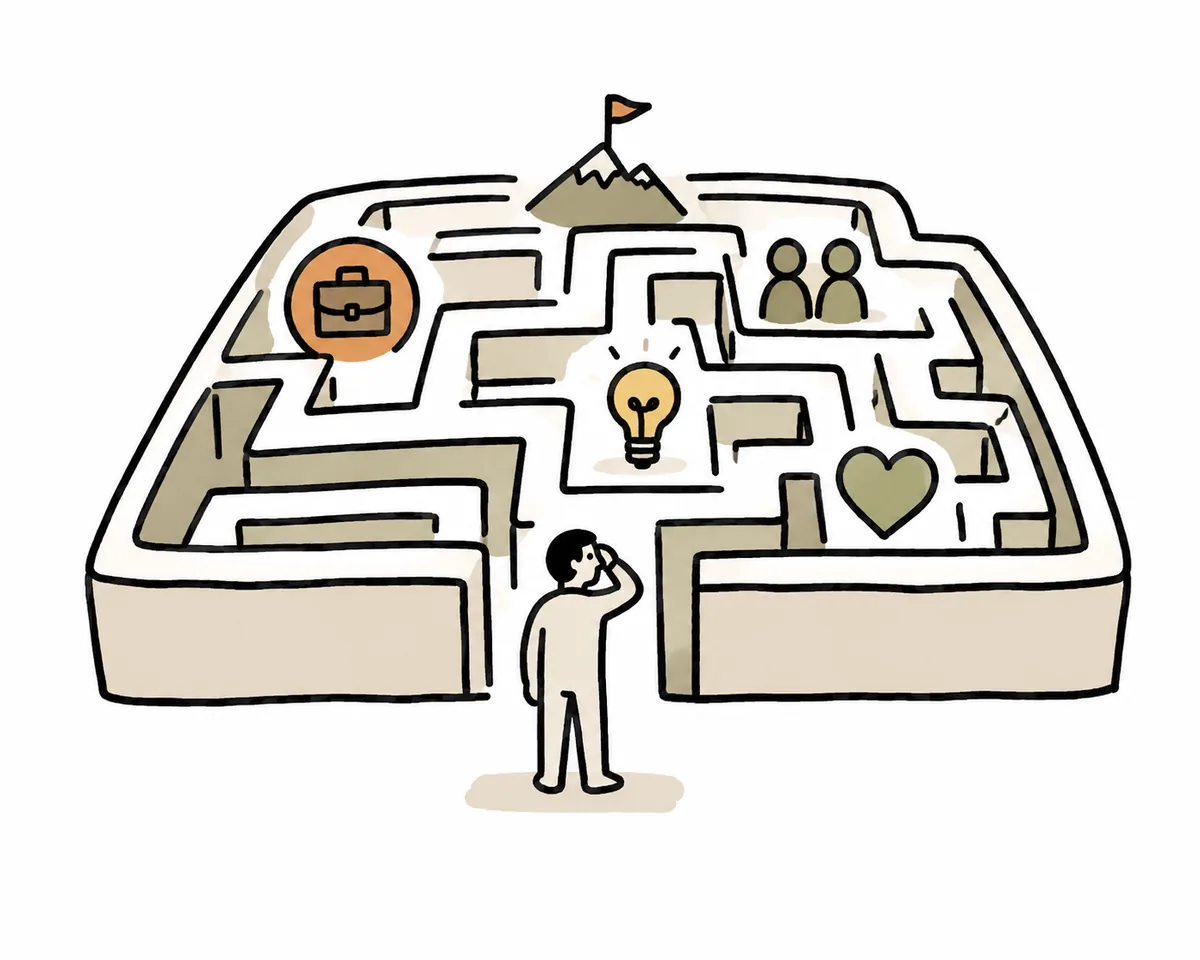
It moved the whole maze.
You've seen what that looks like by now. The 4:47pm calendar invite titled "Org Update." The green "open to work" rings multiplying on LinkedIn every week. The designer with fifteen years of craft, watching an intern produce 80% of her output with a prompt and a subscription.
The numbers agree with your eyes. 110,000 tech workers were laid off in the first quarter of 2026 alone, nearly half of those cuts openly attributed to AI. Malaysia's government has flagged 697,000 jobs as highly affected if workers don't retrain within the next few years. And in Singapore, the group hit hardest by Q1 retrenchments wasn't the unskilled. It was degree holders and older workers. The certificate that was supposed to be the safety net now belongs to the people most retrenched.
And everyone, bosses, ministers, LinkedIn gurus, offers the same recycled word: upskill. SkillsFuture will even throw in six months of free AI tools. Learn AI. Learn prompting. Learn data. Learn everything, and hope one of them sticks.
Here's the part nobody says out loud: you didn't fall behind. You were busy being good at your job, exactly what you were told to do, while the maze changed shape around you. That's not complacency. That's a map problem.
And here's the detail most people mis-read as good news: in Singapore, only about 6% of firms say they've cut headcount because of AI. A larger share did something quieter. They redesigned the roles instead. That sounds like safety. It isn't. It means the maze is being renovated while you're still inside it. Your title stays on the door. Your cheese moves three corridors down, and nobody sends a calendar invite for that.
The wave doesn't need your name
Because here's the other thing about this wave: it doesn't need your name on a retrenchment list to reach you.
Ask the survivor doing three people's work because the team of eight became three, same KPIs, plus new "AI productivity tools" to learn on weekends. Ask the freelancer whose clients didn't fire her. They just quietly stopped calling, because "we do it in-house with AI now." Ask the fresh grad sending his three-hundredth application for entry-level roles that are vanishing from the bottom of the ladder, and the parents still paying that grad's phone bill at 26. Ask the trainer whose course teaches a skill that's automating, or the agency owner watching his quote get compared to a subscription price.
Nobody calls these people "displaced by AI." No headline counts them. But the cheese moved for every one of them. The wave reached their station without ever saying their name.
The Hem trap
In the book, when the cheese runs out, Hem stays at the empty station. He's sure the cheese will come back. It's not fair, he keeps saying. And he's right. It isn't fair.
But watch what Hem looks like in 2026: refreshing the job portal for a title that is quietly disappearing from the market. Sending the two-hundredth application for the same role, one salary band lower each quarter. Telling himself the industry will "correct itself" after this cycle.
And there's a quieter Hem nobody notices: the survivor. Still employed, workload doubled, telling himself that keeping the job means the wave missed him. It didn't miss him. It's just reaching his station last.
The scary part is that waiting feels responsible. It looks like loyalty. It looks like patience.
It's actually the riskiest position in the maze, because your mortgage doesn't care whose fault it is.
The question the book never answers
Quick check. Which character are you right now?
- Sniff smells the change early. He's the colleague who started learning the new tools two years ago, quietly.
- Scurry moves fast the moment the cheese is gone. No analysis paralysis.
- Hem waits at the empty station, certain the old world returns.
- Haw hesitates, struggles, then adapts, and writes what he learns on the maze walls for others.
Most career advice stops here: be like Sniff and Scurry. Move with the cheese.
But the book has a gap, and it's the gap everyone falls into: it tells you to move. It never tells you where.
Running fast in the wrong corridor is just Hem with cardio.
And direction is the part generic advice cannot give you, because generic advice sends five million retrenched people down the same corridor. "Learn AI" is not a direction. It's a stampede.
The maze has a map
This is where I'll say something the productivity gurus won't: direction is personal, and in BaZi, it always has been.
You were born with some energies stronger than others: expression, analysis, building, connecting. And your chart moves in seasons: some years are for planting (training, positioning), some are for harvest (moving boldly). Two people can be retrenched from the same team on the same afternoon, and the right next move for each of them is completely different.
The person with strong expression energy should probably move toward visibility: client-facing work, teaching, building in public, because AI compresses production, not trust.
The person with strong learning energy should go the other way: convert those years of depth into a specialist niche that generalist tools serve badly.
Same retrenchment. Opposite corridors. Both correct, for the right person.
The cheese moved. Your energies didn't. That's the map.
The Maze Protocol: one week
Step one: name your character. Tonight, pen and paper, one line: are you Sniff, Scurry, Hem, or Haw right now, not the one you'd like to be. Nobody will see this paper. Five minutes, and it's the most honest five minutes you'll spend this year.
Step two: sort your cheese. Two columns. Left: skills that belonged to the old station (tool-specific, process-specific, title-specific). Right: skills that travel (judgment, relationships, domain depth, taste). Be brutal. The left column is what AI ate. The right column is what you're actually carrying through the maze.
Step three: get your direction read. This is where people used to ask a master. Instead, ask MingAI. Give it your exact situation:
"I'm a [role] in [industry], [X] years in. My industry is shrinking. Based on my chart, which of my energies should I build my next move on, and is this a season to move fast, or to train first?"
It reads your full chart and answers like a life guide, not a fortune-telling master: direction and timing, based on who you actually are. And it won't just answer; it will ask you a question back that you'll be thinking about for days. It's free to start at mingai.ai.
(No chart reading at all? Run the battery check instead: for one week, note which tasks charge you and which drain you. Your energy design shows up in your battery. The chart just reads it faster and further ahead.)
Step four: smell the new cheese before you move house. Whatever direction came out of step three: run one small experiment in the next 30 days. One freelance project. One weekend prototype. One paid workshop. Do not resign into the void, and do not bet the savings. Test the corridor while you still have a station.
The honest part
Let me say it upfront: I built MingAI, and not only for myself.
I kept seeing people make the biggest decisions of their lives (leaving jobs, switching industries, moving overseas) armed with advice that doesn't even know who they are. Generic advice moves five million people into the same corridor. Your chart doesn't.
The cheese isn't coming back. It never was. The book told us that in 1998. But you were never built to sit at one station forever. Nobody is.
Hem waits for old cheese. Haw walks.
You? You walk with a map.
Kit Fung Chai is the founder of Cortexum, a Singapore applied AI studio, and the maker of MingAI, an AI life guide grounded in BaZi.