
Design without a designer
What the brain, evolution, and gradient descent have in common, and where the honest version of the creation question really lives.
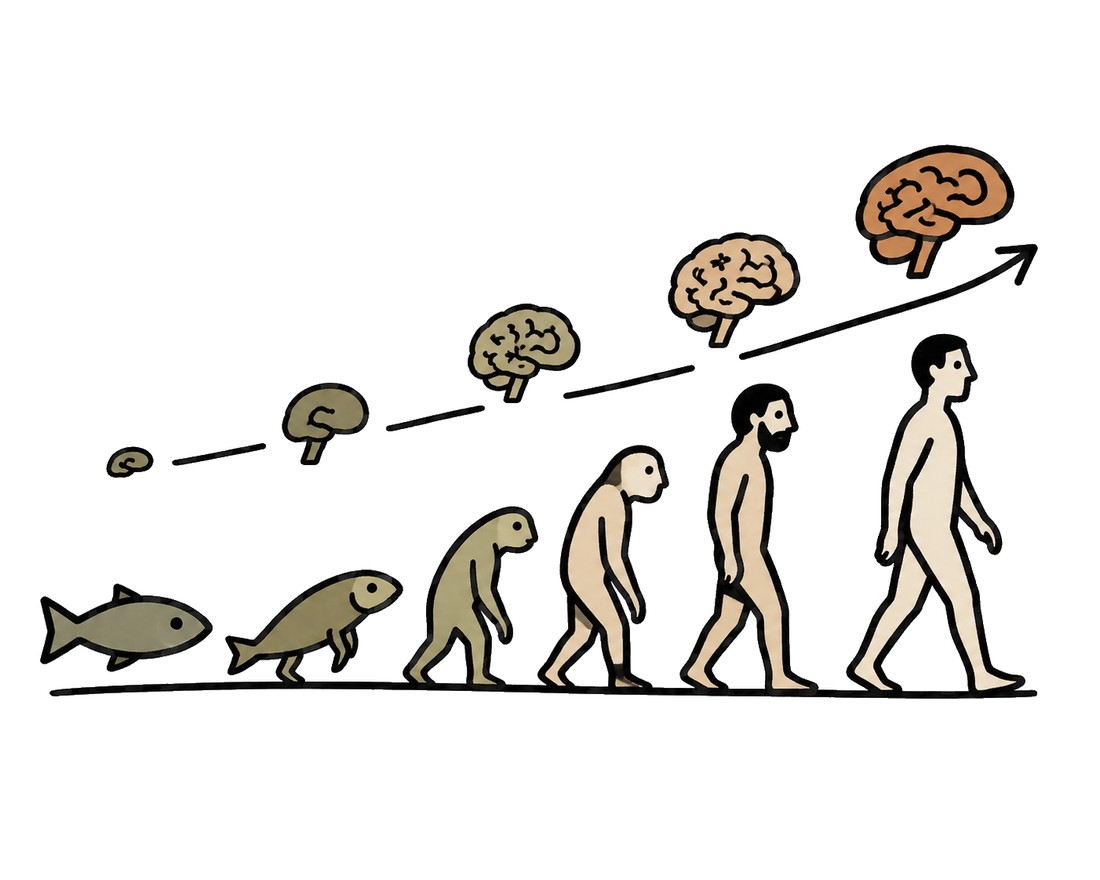
The honest answer is evolution. The evidence for it is overwhelming. But the way we usually frame it, creation versus evolution, is half wrong, and the wrong half is the part worth talking about.
The brain carries its history
The evidence isn't close. The brain carries its history the way a trained network carries its growth rings. It is built inside out and back to front. The brainstem and limbic structures we share with lizards sit at the core, with the neocortex laid on top. That is the pattern you get in any system that has to grow by adding to what is already there, because it can never stop and rebuild from scratch.
The retina is wired backwards, with the photoreceptors sitting behind the nerve fibres. No designer would do that. But a lineage that started with a light-sensitive patch, and could never start over, would be stuck with it. The recurrent laryngeal nerve loops all the way down around the aorta and back up again, for no reason except a fish ancestor's plumbing. None of this looks like design. It looks like descent that cannot undo its own past. The anatomy records the route, not just the destination. A designed brain would have no growth rings. This one is nothing but rings.
The wrong cut
So why is creation versus evolution the wrong way to cut it? Because the instinct behind creation is picking up on something real. The brain does look designed. It has the appearance of purpose, of parts that fit their function, and that appearance is not an illusion to wave away. It is a real fact, and it needs an explanation.
Here is what evolution actually says. You get design without a designer once descent under constraint runs long enough. The creation instinct sees the design correctly. It just reaches for the wrong cause, assuming a maker, because it cannot yet see that the constraint itself is doing the shaping.
The same mistake, reading a network
You can make that same mistake reading a neural network. Watch a model take shape under gradient descent and it is tempting to think its inner structure was put there on purpose: a designed workspace here, a deliberate subroutine there. But nobody is in the loop building it. What looks designed is something the training grew and could just as easily dissolve, shaped by what the constraints ruled out rather than by any hand. The look of design turns up at the scale of a single mind, biological or artificial, and in neither case did anyone put it there.
Evolution isn't the opposite of creation. It's how creation happens when there is no creator.
The universe does not need a creator in order to get creation, because descent under scarcity already generates design with nobody running it. The genome is the ash of four billion years of the same process that shapes a model in a few weeks of training. Same destination, different material, a much slower clock.
The part that doesn't dissolve
There is one version of the question that does not dissolve, and it shouldn't. The process runs under rules. A universe has to exist in which scarcity, locality and noise settle into structure instead of mush. The constants have to allow stable chemistry. Gradients have to lead somewhere worth settling at all. None of that was produced by evolution. Evolution takes it for granted.
So the real leftover isn't "who built the brain," because the process did. It is "why is reality the kind of place where a blind process builds brains in the first place." Physics pushes the question up one floor. Maybe those rules are themselves selected, out of a multiverse or through some anthropic filter, which is only descent again one level higher. But it never fully closes. That is where the honest version of the creation question sits. Not in the brain, which plainly grew, but in the lawfulness that lets anything grow. And the only honest answer there is that nobody knows, and you should be wary of anyone who says they do, in either direction.
The brain comes out of evolution the way a model comes out of gradient descent. No author, just the process. But the process does not explain itself. Someone who looks at a brain, feels the awe, and calls it "created" has the mechanism wrong and the awe right.
Cortexum is a Singapore-based applied AI studio building custom AI agents, domain-specific models, and the software that carries them into production.