
Stop being your business’s approval bottleneck
Your team can handle more without calling you for every decision. Start with clear authority, reliable records and a workflow that brings you the exceptions.
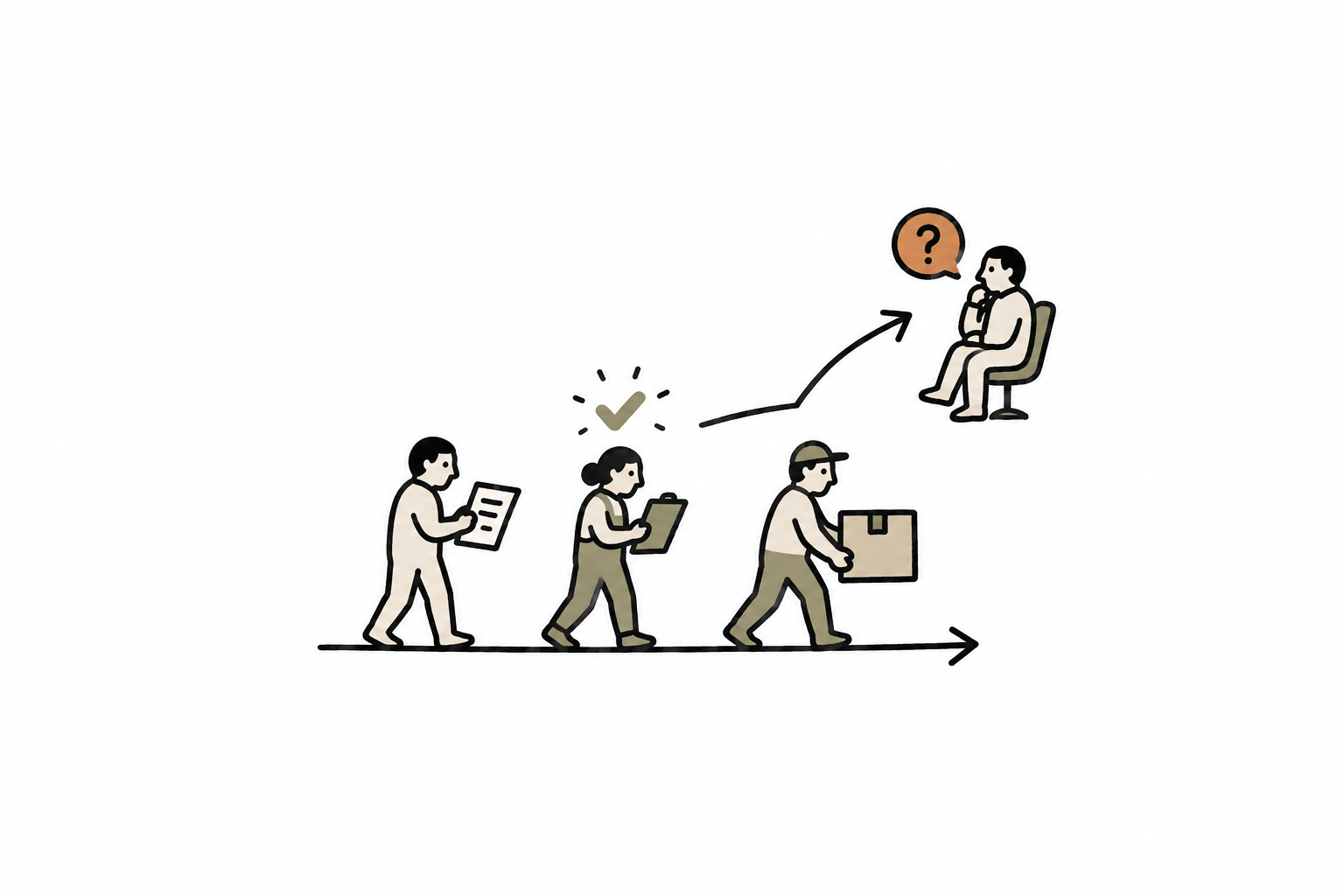
Your phone rings during dinner. A customer wants to add two items to an order. The team needs to know whether there is enough stock, whether packing has started and whether someone must approve the change. You open the chat, ask three questions and make the decision yourself.
The task belongs to your employee, but the decision still belongs to you. As the business grows, that arrangement creates a queue with one person at the front: the owner.
Each interruption has a decision cost. Someone gathers the facts, someone waits, and you stop another piece of work to reconstruct the situation. A small request can consume several people?s time. A useful workflow reduces that cost by making the decision, its owner and its supporting information explicit.
1. Write the authority into the SOP
A standard operating procedure usually explains how to do something. It should also explain who may decide, within which limits, and when to ask for help.
?Check with the boss if necessary? leaves the difficult part unresolved. An employee who is unsure how you will react has a sensible reason to call you. Clear authority gives them a safer way to act.
For one recurring decision, write down six things:
- Trigger: what request starts the process?
- Required facts: what must be known before anyone decides?
- Conditions: what makes a request eligible?
- Authority: who may approve it, and within what limits?
- Exceptions: when does it need another person?s judgement?
- Evidence: what should be recorded and who needs the update?
These rules only work if you honour them. If a supervisor follows an agreed policy and is criticised for not asking first, the next request will come straight back to you. Review an inadequate rule with the team, record the change and apply the new version going forward.
2. Turn repeated decisions into system checks
Consider an illustrative order-change policy. The figures below are examples for discussion, not recommended limits for every business.
| Check | Example rule |
|---|---|
| Order status | Packing has not started. |
| Stock | Available stock covers the additional quantity after existing reservations. |
| Commercial terms | Approved unit price and delivery date remain unchanged; the customer accepts the revised total. |
| Approval limit | Added value is at most S$200 and quantity increases by no more than 10%. |
| Authority | An assigned order coordinator may confirm a change within these limits. |
| Exception | A failed or unknown check goes to the supervisor; a margin or delivery commitment exception goes to the owner. |
The system reads the current order and stock records, calculates the change and checks the conditions. If every condition passes, the authorised coordinator can confirm it. If one fails, the request arrives in a review queue with the reason already attached.
Authorised staff confirms
Update order and stock reservation
Send exception to named approver
Keep existing order unchanged
Successful implementation requires more than a green ?Approved? label. The order change and stock reservation must be saved together, so another employee cannot allocate the same stock in between. In technical terms, this is an atomic update: either the related changes succeed together or none of them is committed.
The system should also recheck the order when approval is submitted. Packing might have started while the request was open. Repeated clicks or a resent WhatsApp message must not create the change twice. A unique request reference makes retries safe.
If the warehouse notification fails, show that failure and retry it. ?Order updated? and ?warehouse notified? are separate outcomes. Staff should be able to see both.
3. Delegate the decision, then review the exceptions
Once the rules and records are dependable, assign routine authority to the people closest to the work. Give the coordinator a defined range, the supervisor a wider range, and the owner the decisions that change commercial commitments or carry unusual risk.
An escalation should arrive as a decision pack: the original request, proposed change, current facts, failed checks, financial effect and named approver. The owner should be reviewing a prepared exception rather than searching through a week of messages.
Permissions must be enforced by the system, including requests submitted through chat. Asking an AI assistant to approve a purchase should not give a worker authority they do not have in the backend.
Keep a history of who requested, reviewed and approved each change, which rule version applied, and what changed in the underlying record. That history helps resolve disputes and reveals where the policy needs improvement.
Where AI helps
AI is useful when the input is messy: a WhatsApp message, a supplier PDF, a photograph of a delivery order or a free-form description of a problem. It can propose structured fields, retrieve the relevant procedure and prepare a summary for review.
The arithmetic, permissions and approval thresholds should be handled by explicit system rules. For example, AI can interpret ?add two more of the same model?; the workflow still needs to confirm which order and model, check current stock, calculate the revised value and verify the employee?s authority.
| Use AI to assist | Use rules and controlled records |
|---|---|
| Extract an order reference from a message | Verify that the order exists and belongs to the right customer |
| Read proposed quantities from a document | Validate units, calculate totals and check stock |
| Summarise why a request needs attention | Select the authorised approver and preserve the audit trail |
| Draft a customer update | Confirm what actually succeeded before sending it |
When information is unclear, ask for clarification. A plausible guess about a product code or price can turn a quick approval into an expensive correction. Uploaded documents and customer messages are inputs to assess; they do not get to rewrite your approval policy.
Start with one decision that interrupts you every day
You do not need to replace every spreadsheet or rebuild the company?s systems at once. Choose one bounded workflow with frequent requests, reliable source data and mistakes that can be corrected. An order amendment or routine replenishment request is a useful starting candidate.
Collect a few real examples, including one you approved and one you refused. Write the rule with the employee who handles the work. Agree who owns exceptions and how long a request should wait before it is escalated.
Run a pilot in review mode first: the system proposes the route, while staff confirm each outcome. Test missing stock data, duplicate submissions, simultaneous changes, unavailable approvers and failed notifications. Only enable routine approval once the results match the agreed policy.
Measure requests handled, time spent waiting, owner interruptions, corrections and exception reasons. Fewer calls to the boss is useful only if the work remains accurate and the team can still raise a real problem.
At the end of the pilot, improve the rule that produces the most unnecessary escalations. Then decide whether a second workflow is worth adding. The objective is a business where staff know what they can decide, the system supplies the facts, and you spend your attention on the decisions that need you.
Tell Cortexum which decision keeps coming back to your phone. We can help map the process, define the approval boundaries and build a focused workflow around it.
Cortexum is a Singapore-based applied AI studio building custom AI agents, domain-specific models, and the software that carries them into production.