
A model that knows your work, not just the internet.
General models are broadly capable and specifically average. When the task turns on judgement your industry took decades to build, we train for it: your data, your vocabulary, your definition of a good answer.
Not sure whether training is the answer?
 Ask Cora for a free brief
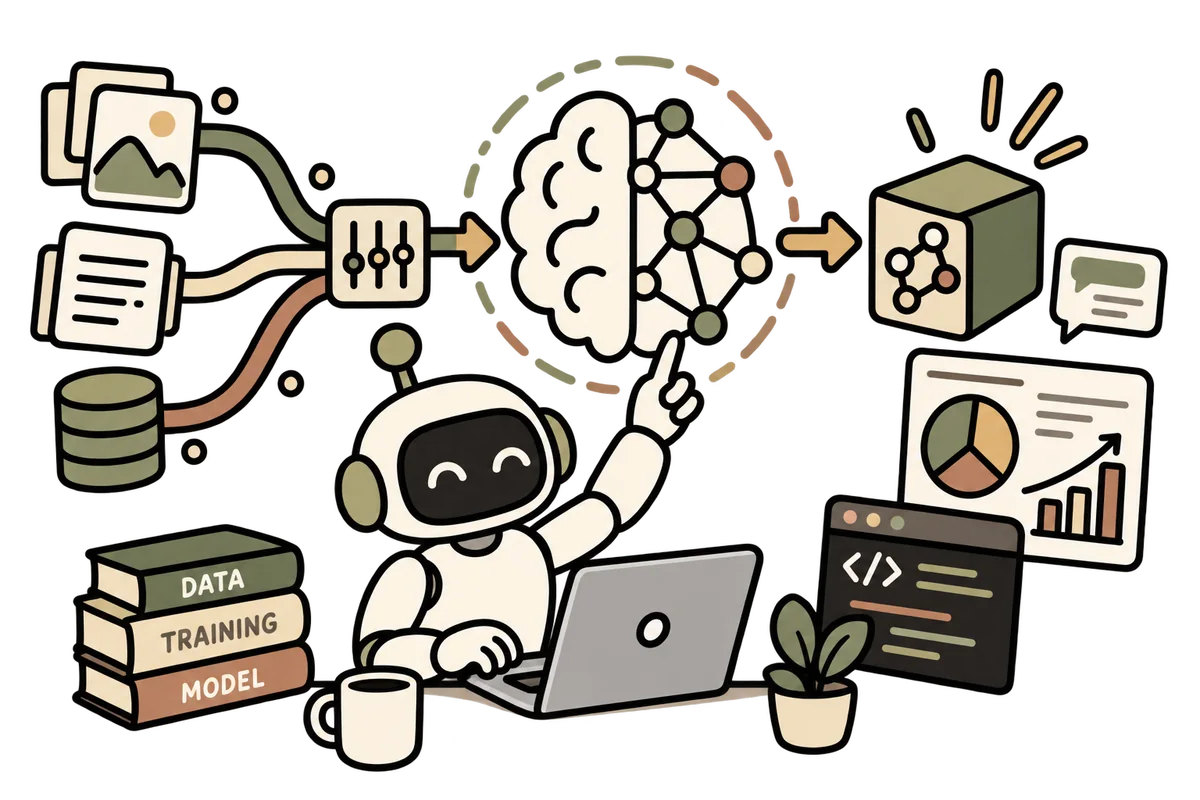
Most of the time it is not, and we will say so. Prompting and retrieval are cheaper, faster to change, and solve the majority of problems. Training earns its keep in four situations: the task needs judgement a general model has never seen, the language is genuinely specialised, latency or cost demands something smaller, or the work has to run on hardware you control because the data cannot leave the building.
If none of those apply, we will point you at the cheaper answer and keep the conversation short.
The dataset is the product.
Dataset Design & Curation
Nearly every disappointing model traces back to its data. We work out what the model must learn, where those examples will come from, who is qualified to label them, and how disagreement between labellers gets resolved. A few hundred well-chosen examples usually beat tens of thousands of noisy ones.
Fine-Tuning & Distillation
We pick the smallest approach that reaches the bar: a light fine-tune, distillation from a larger model into one you can afford to run, or continued pretraining when the domain vocabulary is genuinely foreign to the base model. Each run is versioned and reproducible, so you can always tell what produced which result.
Evaluation That Means Something
Public benchmarks tell you how a model does on someone else's problem. We build an evaluation set from your cases, with your experts defining what a good answer looks like, and score every candidate against it. That is the only number that should decide whether a model ships.
Deployment-Ready Delivery
You get a model you can actually deploy: quantised for the hardware you have, served behind an API or embedded in your product, with the weights, datasets and training code handed over. If you would rather we ran it, we can, but you are never locked in.
Agree the target before the first run.
Define
What the model must do, who judges the output, and the number that decides whether it worked. Agreed before training starts.
Build the data
Sourcing, cleaning, labelling and the held-out set. The longest phase, and the one that determines the result.
Train & evaluate
Successive runs scored against your evaluation set, with error analysis after each, until the curve flattens.
Deliver
Quantised, deployed where you need it, with the weights, data and code handed to your team.
Trained, then shipped.
MingAI
A domain where general models are confidently wrong: the vocabulary is specialised, the reasoning is structured, and enthusiasts spot a bad answer instantly. We trained a domain-specific model, built the agents around it, and shipped the product surface too, a web application and native Android and iOS apps. Live at mingai.ai.
Gafung Petroleum
An AI workflow for inventory and cost management in a business whose categories, units and supplier quirks look nothing like anything a general model was trained on. Built alongside the web presence that surfaces it to their team. Live at gafungpetroleum.com.my.
The things people ask first.
Do we actually need to train a model?
Often not, and we will tell you. Prompting and retrieval are cheaper and easier to change. Training earns its place when the task needs judgement a general model lacks, the vocabulary is specialised, cost or latency demands something smaller, or the work must run on your own hardware. We test the cheap options first.
How much data do we need?
Less than most teams assume, but it has to be the right data. A few hundred well-chosen, correctly labelled examples usually beat tens of thousands of noisy ones. If the data does not exist yet, we help design how it gets collected and labelled.
How long does it take?
Four to twelve weeks. The dataset is usually the long pole rather than the training itself, and the evaluation is designed up front so there is an agreed definition of better before the first run.
Who owns the model and the data?
You do. Weights, datasets, evaluation sets and training code are yours on final payment. Runs happen in your cloud or a tenancy you control, and your data is never used to train anything for another client.
Can it run on our own infrastructure?
Yes. We deliver quantised, deployment-ready models that run on your servers or at the edge, which is often the whole point in regulated industries where data cannot leave the building.
What if a better base model launches next month?
Expected, and it is why the datasets and evaluations matter more than the weights. Those assets are portable: retraining on a stronger base is a short run rather than starting over, and your evaluation set tells you immediately whether the new model is actually better for your work.
Tell us where the general model falls down.
Send us the cases a general model gets wrong and we will tell you whether training will fix them, what data it would take, and roughly how long. If prompting or retrieval would do the job, we will say that instead.